
So you’ve signed the contract. You’re becoming an expat for the first time. How exciting! But, what happens now??
There are many aspects of expat life that don’t make it into the glossy company brochures. Whether you’re relocating for work, family, or a fresh start, being prepared will make your transition smoother.
Here’s a comprehensive guide (compiled by a seasoned expat!) to all the things you really need to know when moving overseas for your first expat assignment.
The Do’s: Setting Yourself Up for Success

1. Do – Understand Your Office Expectations & Commute Times
Every organization has different policies regarding office attendance. Before you can even think about choosing a home, neighborhood to live in or school for the kids you’ll need to clarify:
- Where your office is located? AND how often you’re expected to be there?
- How much flexibility will you have? Is remote work an option?
- What are the public transport options and commute times? Don’t underestimate how long it takes to get to work, even in cities with excellent transport
- Try to get an understanding also of the typical office hours and workplace culture in your new country. Some offices generally have earlier or later start times (Singapore 9-10am, USA/Australia 8-8:30am, Japan 7:30-8am), long lunch breaks (Spain, Italy, Greece etc.), or different working weeks (Dubai offices are open Sunday to Thursday).

2. Do – Research Schools That Align with Your Needs
If you have kids who are joining you on this expat journey, choosing the right school and it’s location is crucial. There are usually many great options, but you’ll want to consider the following when doing your research:
- Availability: Local english speaking schools may or may not be an option in your new country. Often there are waitlists or special requirements to attend local schools. It’s not as easy as arriving with your visa and enrolling your child/children. Some schools require you to live within a zoned catchment area (Australia), or apply during a specific annual application entry time frame (American charter schools), or speak the local language as well as english (Zurich, Singapore etc).
Pro Tip: Popular schools may have waitlists! You’ll likely need to submit extensive paperwork in the application. Secure school placements as early as possible to avoid last-minute stress.
Your Budget: If local school’s are not an option, there are many great international schools available world-wide with a range of curriculums. Fees vary significantly, and you may want to note that costs often increase % annually! Check if your expat package will include school fees, this isn’t a common practive much anymore but you could always try to negotiate.
Pro Tip: Some schools require tuition payments up to six months in advance, which can impact cash flow. Check for hidden costs like meals, transport, and activity fees.
- Education Standards and Curriculum: Research the curriculum that aligns best with your expectations. International schools will all offer different curriculums and have pros/cons to each. You have American (AP & Common Core), Brittish (IGCSE & A-Levels), International Baccalaureate (IB), French (Baccalauréat Français & AEFE), Canadian, Australian, Reggio Emilia, Montessori, Waldorf etc. Also think ahead to the future and what happens after you expat assignment. If you’re going be away for 2 years what is the curriculum your child will be reintegrating back to? If you’re away for 3-5 years, what are the curriculum requirements for high school or the college/university you want your child to attend?
- Location: Factor in where the school is located. Will there be a long commute (car or public transport) or additional school bus fees? If you want your child to be
Pro Tip: Most families will want to live in close proximity of the school, for easier commute time. But the other bonus is that any friends your child makes, it will become easier to organise play dates and catch up’s if you live locally.
- Family values: This one is super important and will help you ultimately make the decision. Check out the school’s mission and values statements, look at their social media (you tube, Facebook), google search their ratings/comments, read articles and the principal messages to see if the way the school has been portrayed resonates with your family’s core values.
- Extracurricular activities: Does the school offer specific sports, arts, hobbies, or languages that your child is interested in? Every school will differ widely in their options and what they offer.

3. Do – Find a Neighborhood That Works for Your Lifestyle
- Know Your Budget: Is a housing allowance included in your expat package? (it’s not super common these days but sometimes can be negotiated) Will this allowance cover the full rent for the style of living you/your family requires? If it’s not covered, know that housing in some expat destinations the costs are outragious!! (Singapore, Hong Kong, Zurich, central London, Dubai, New York etc) For the size of what you can get it’s likely no comparison to your home country. It’s better to set those expectations early on.
- Style of Living: What type of house or apartment do you want to live in? Do you like modern and open plan, or older style with character and features? What are your non-negotiables? If you’re moving to a warm climate do you want a pool and air-con? Do you need a garage for a car or an extra study for remote working? These factors may determine where you’ll live and what you can find.
- Location, Commute & Public Transport: The truth is, long commutes can add stress to your daily routine. Define the major priority – is it being closer to work or closer to school/local activities that are important to you? If you’re living city central is there ample public transport?
- Other Things to Consider: Google will help you understand the safety and walkability score for the city you are looking to move to. Also look for amenities and activities that are important. Is there a supermarket, gym, child care within 5-10mins drive/walk/transport?
Pro Tip! Research Housing Markets Early—what’s available now may change quickly! Every country will have it’s own real estate apps, google the top two rental apps and start your search.
- Understand the local rental terms: Lease terms and contracts vary for different countries. In Australia and the USA you might be able to organize a 6 month lease if you aren’t 100% on the location you want to live. But typically in most countries a 12 month lease is the norm. In Singapore all leases by law are 2 years, which is in line with your expat working visa, so you’ll want to make sure the area you choose is exactly where you want to live!
- Hire a rental agent: If you’re unfamiliar with the local rental market, a real estate agent can help navigate contracts and negotiations. Some countries favor landlords (Singapore) rather than tennants (Australia), and can make it difficult for tenants to get deposits back. Understand your rights. But also be aware that agent fees can be high in some locations (Singapore – up to half a month’s rent!).
- Be flexible: Your ideal neighborhood may not have available housing when you arrive. This happens often! You may have your heart set on X but it’s likely you’ll need to compromise on some things. Just know your 1-2 major priorities and be flexible on the rest.
Pro Tip! Push your company for a look-see trip! This is your opportunity to scout out locations, schools and neighborhoods. We didn’t do this for our move to Singapore (due to pandemic restrictions). Unfortunately, I spent the first 2 wks on arrival trekking around in the humidity searching for an apartment on my own. NOTHING was available and we ended up 40mins away from our chosen school. Being on “the other side of the island” meant costly bus fees ($3k SGD yr!) until he was old enough for public transport. However, both of our moves to the USA we had look-see trips and it was brilliant! We secured a house prior to moving and got straight into our new home within days of arriving.

4. Do – Look Into Local Sports Clubs, Associations & Social Clubs
- Know your budget: Many countries have sporting clubs out side of schools with professional coaching, which can be expensive. For example, in Singapore we paid $1k SGD a term for my son’s basketball, whereas in Australia the same scenario was only $250 AUD. If you or your child is used to playing multiple sports you may have to factor this in.
- Look for community associations and clubs: Some expat communities run social leagues that can also be a great way to meet people. For example, in Singapore the Australian & NZ Association hosted local sports for all ages, social activites and art/craft groups, and tours. For a small annaul membership anyone could be part of their events and programs. Other associations like the American, Brittish or Swiss Club operated more like a country club with communical facilities – gym, pool, common games rooms, dining etc with a much higher annual premium.

The Don’ts: Avoiding Common Pitfalls as a New Expat
Here’s where we have some “real talk” about the unexpected challenges that can catch even the most prepared expats off guard. From housing mistakes to financial missteps, knowing what not to do can save you stress, time, and money. Here are some of the most common pitfalls and how to avoid them for a smoother transition into your new life.
1. Don’t – Sign a Lease Without Seeing the Property in Person
- Virtual tours can be deceiving: You want to get a look and feel for the rental in person. Especially if you are moving to a humid climates where the number one issue is mold!! These issues may not be visible over the screen when you’re doing the virtual walk through. Real estate agents can also “omit” or gloss over certain important aspects when showing you online.
- Some rentals look great in photos but have serious issues like noise from construction, pollution, or poor maintenance. You want to make sure during your walk through that you’re moving into a place that is going to make you feel safe and comfortable.
2. Don’t – Overcommit Financially
- Understand what is covered/not covered in your contract: Do you get full relocation/move support? Housing allowance? School fees paid? Full or part health insurance? Do not secure a home until you know all of these things! Go back, work out the $ details – THEN start your housing search.
- Moving is expensive and hidden costs add up VERY quickly. It will be tempting on your first expat assignment to max yourself out in the excitement of it all. “Sure we can afford that house, book that trip, buy that car!” Then you don’t realize certain tax implications, or that international school fees go up EVERY year, and bus transport is outragious. As much as you can – keep a financial buffer for “unexpected expenses” in that first 6-12 months. You won’t know until you are living day to day in the new city what your exact expenses will be.
3. Don’t – Assume You Know ALL the Visa & Legal Requirements
- Immigration laws change frequently! Research all of the working and living visa requirements, work permits, and residency rules before making decisions.
- Some countries may have language requirements: For example, in Dubai Arabic/Arabic studies are mandatory as a subject from Grade 1 to Grade 9 at all international schools. In Zurich a dependant spouse must learn A1 basic proficiency German skills within the first 12 months of living there.
- Check whether your spouse can work (or run a business) in the new country and what the process entails. Don’t assume it is a given! For example, I spent almost $15K SGD in the first two years living in Singapore to adhere to requirement to obtain a working visa for my business.
Pro Tip: Ask For Local Knowledge in Forums Before You Leave – In Singapore a saw a lot of dual income families caught out by the high cost of living due to the fact that they assumed their highly educated and experienced spouse would easily get a job, even thought they were on a Dependant Pass visa where the rules stipulate a DP cannot work. A simple “sense check” in a local Facebook group would have reset the real expecations.
4. Don’t – Assume You’ll Adapt Instantly
- Culture shock is real! It’s a natural part of the expat experience—navigating new customs, languages, and daily routines can feel overwhelming at first, but with time, patience, and an open mind, it becomes easier. Even in countries where you CAN speak the language, adjusting to a new way of life takes time.
- Weather can affect your energy levels: For example, living in the humidity of Singapore and travellling on public transport daily meant that I could really only commit to getting 2-3 things done on my errand list without being utterly exhausted. Where as in Australia I could easily zip around in my car and get double the amount done in a short time.
- Weather can affect your moods: While living in the mid-west USA and experiencing living in snow for the first time ever, I began to understand the term “seasonal depression”. After not seeing a single day or crack of sunshine during the entire month of November. Coming from Australia I remember thinking “How to people live like this!!”, the good news – you get used to it.
- Give yourself grace and be patient—it can take 6-12months to feel truly settled in your new environment!
Pro Tip! Reverse culture shock is a thing! The first few weeks after moving from Asia to America hit me hard. I couldn’t get used to everything feeling so big, after the confined feeling of Singapore. The loudness and level of “noise” around me also bothered me. I had a melt-down one day in Target while trying to buy laundry detergent. In Singapore you had 1-3 options, it’s this OR THIS. In America there was 2-3 AISLES of detergents lined up on shelves to choose from!! The decision felt overwhelming.

Ready to Make Your Move?
Moving abroad is a huge step, but with the right preparation, it can be an incredibly rewarding experience.
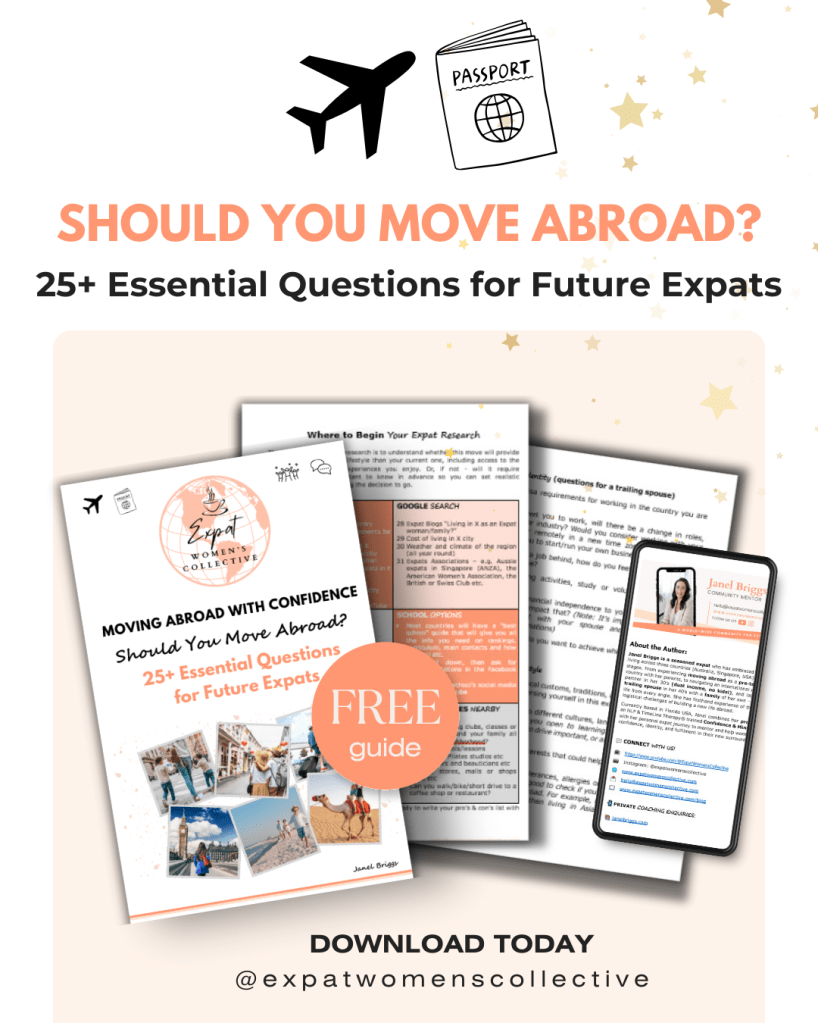
To help you even further navigate your transition more smoothly, I’ve created a 25-Question Expat Planning Questionnaire that covers everything you need to consider before relocating.
Download your free copy here: start planning your move with confidence!

ABOUT THE AUTHOR:
Janel Briggs is the founder of The Expat Women’s Collective. Having navigated multiple international moves across different life stages, she understands firsthand the challenges and rewards of expat life and relocating your entire world abroad.
As a Confidence & Mindset Coach since 2018, Janel has spent years empowering women with the tools to embrace change, rediscover their identity after major life transitions, navigate uncertainty and anxiety, and rebuild fulfilling rewarding lives, relationships and careers.
Questions or comments? Get in touch! hello@expatwomenscollective.com


Leave a Reply